Discovery of Paul Ulrich's Storage Locker Contents
Dr. DeathThe discovery of Paul Ulrich’s storage locker contents turns a concealed cache into a material record of his double life: four carefully ordered cartons preserve traces of victims, clothing, possible trophies, and tools, while the locker’s cooling parcels and working firearms deepen the danger of what remains unknown. The investigation finds not a single decisive explanation, but an organized accumulation whose objects make Ulrich’s violence harder to treat as an isolated crime.
Discovery and Investigative Context
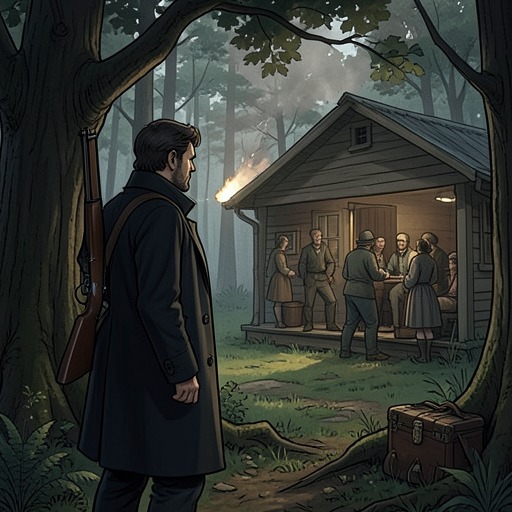
A key found in Ulrich’s bedroom nightstand led investigators to a storage locker in Panorama City. The house itself had yielded nothing especially interesting, and Tanya Stratton had vacated the premises within days of the Malibu shooting. The locker therefore offered a different kind of evidence: private material kept apart from Ulrich’s home and found through a small, practical clue rather than an obvious display.
By late November, a month and a half after Eldon Mate’s slaughter, Milo Sturgis had finished cataloguing the contents of the four cartons. The narration places that completed work weeks before Alex Delaware’s drive to Lancaster, so the locker’s discovery and inventory reach the reader retrospectively. That delay matters to the unfolding investigation: a key opens onto an archive that has already been examined, but whose details now sharpen the meaning of Ulrich’s identity and the case against him.
The locker was rented in the name Dr. L. Pasteur. Its alias sits uneasily beside its methodical contents: the cartons were beautifully organized, and the objects within them had been preserved, sorted, or stored with care. The arrangement makes the cache more than a miscellaneous hoard. At the same time, the evidence does not explain every object’s origin or establish the contents of the wrapped parcels; the cataloguing reveals patterns and raises questions without resolving them all.
Four Cartons of Evidence
The first carton held newspaper clippings folded and filed in chronological order, each tagged with a victim’s name. Among the material were meticulously preserved details of Roger Sharveneau’s suicide and the death of Victoria Fusco, who had been a teenager. The clippings turn public accounts of death into a private index. Their chronological filing suggests sustained attention to the events, while the victim labels make the collection’s organizing principle unmistakable.
The second carton contained carefully pressed clothing, predominantly women’s undergarments, along with dresses, blouses, and neckties. The third held more than a hundred pieces of jewelry, each in a plastic sandwich bag. Most were of little value and some were vintage costume pieces; a few could be traced to dead people, while the origins of the rest remained unknown. Pressing, bagging, and sorting give these intimate, ordinary objects an unnerving stillness. Their careful storage contrasts with their uncertain provenance: the evidence connects some pieces to the dead but cannot account for all of them.
The fourth and largest carton contained a Styrofoam cooler. Inside it, parcels wrapped in butcher paper had been layered and preserved with dry ice. The storage-facility attendant remembered the renter as a friendly man with a large, old-fashioned mustache who came by roughly every week to make small talk about athletics, hiking, and hunting. By the time of the investigation, it had been a while since his last visit; much of the dry ice had melted, and the carton had begun to reek. The parcels were left for the coroner to unwrap. Their contents are not disclosed here, making the cooler both a concrete piece of evidence and an unresolved boundary around the investigation.
Weapons, Tools, and the Case Against Ulrich
In a corner of the locker were several rifles and handguns, all oiled and in working order, together with boxes of bullets. The cache also included two sets of Japanese surgical tools and another set made in the United States. These items give the collection a more immediate forensic and practical dimension than the clippings and keepsakes: the guns were maintained and usable, and the surgical instruments echo the methods associated with Mate’s killing.
That echo has a specific investigative context. Mate was murdered in a van near Alex Delaware’s home, and Milo had previously described a scene in which the killer took extraordinary care to keep blood from the ground, using the passenger side of the van to clean up before leaving. The police had no report of another vehicle, although the van itself had gone unnoticed for hours. The locker does not, by itself, prove who used any particular instrument or connect each stored object to a specific crime. It does, however, place surgical tools and a collection of victim-linked material in the possession of the man under suspicion for Mate’s murder.
Interpretation and Aftermath
The attendant’s recollection makes the alias and the inventory more chilling by setting them against ordinary routine. The renter visited regularly, offered pleasantries, and spoke about familiar outdoor interests; behind that unremarkable social presence, the cartons preserved clippings, clothing, jewelry, and parcels requiring dry ice. The locker’s contents reveal concealment through organization rather than disorder. Each category has been separated and maintained, even where investigators cannot identify every item or yet know what the cooler contains.
The public account that follows frames the discovery in the language of police consequence: a newspaper headline describes the man killed in a police shooting as believed responsible for Eldon Mate’s murder. That framing makes the locker part of the case’s aftermath as well as a source of evidence. Ulrich’s death does not erase the questions stored in the cartons; instead, the inventory supplies investigators with a physical record to interpret after the suspected killer can no longer be questioned. The locker’s most disturbing effect is therefore cumulative: no single object tells the whole story, but their ordered presence turns a hidden storage space into an archive of violence, possession, and unresolved identification.